
Golden Genie Casino on a handset — your slot reels, your cashier, your live tables, all reachable through Safari or Chrome without a single download.
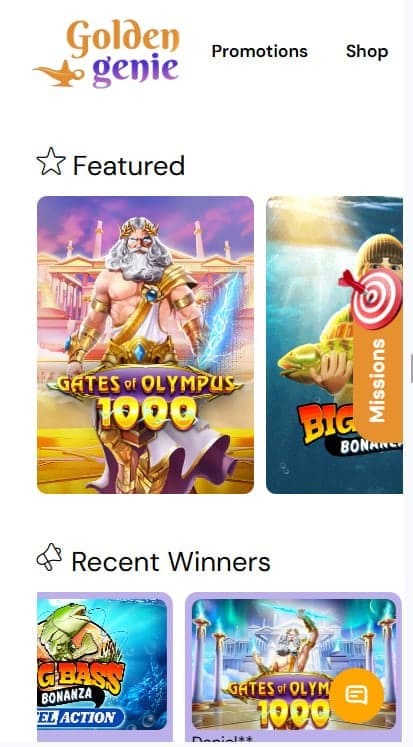
Handset access at this brand runs through one delivery layer only — the responsive HTML5 lobby loaded inside Safari, Chrome, or any other modern phone browser. Apple's App Store plus Google Play both restrict real-money casino downloads across the British market, which leaves the operator following the standard offshore-segment pattern of skipping any native package entirely. We worked the site across an iPhone 14, a recent Pixel handset, plus an older mid-range Galaxy device; the cashier, the spin engine, the streaming room player, alongside the document-upload flow all rendered identically across the trio with no behaviour drift versus a desktop session. The page below walks through the practical mobile journey, identifies where it sits below UKGC-licensed app experiences, plus explains how a phone-only reader can extract the smoothest workflow from this property.
Coverage tracks each step a typical mobile session goes through: opening the lobby cleanly, pinning a home-screen icon for near-app behaviour, performance under weaker signal conditions, security observations around any APK package floating outside official channels, plus the realities of handling cashier work and identity submission on a small display. Every observation reflects browser-based testing across UK-region handsets connected over standard carrier networks rather than Wi-Fi.
| Access Path | How It Operates | Best Suited For |
|---|---|---|
| 🌐 Direct Browser Session | Open Safari, Chrome, Firefox, or Edge; navigate to the operator's main domain; no install step at any stage | Casual visitors, infrequent players, anyone preferring to avoid storage commitments on their device |
| 🏠 Home-Screen Shortcut | Save a bookmark via the share menu — the icon launches the lobby in a dedicated tab using a single tap | Regular players wanting near-app speed without committing to any actual installation |
| 📲 Third-Party APK File | Sideload packages occasionally surface through operator-adjacent forums or mirror domains — installation requires enabling "unknown sources" inside Android settings | Hard to recommend at all — the security exposure outweighs any convenience gain · iOS handsets cannot use this route in any case |
The third option carries security trade-offs the browser path avoids entirely, and we will return to that point further down because it matters. For the majority of readers, route two — a home-screen icon over Safari or Chrome — delivers everything practical without the APK exposure attached to less-official packages.
The result mirrors near-launcher behaviour without invoking any installation step at all. Opening that icon takes you straight into the lobby with a single tap. Safari handles cookie persistence, document uploads via the device camera, plus streamed-room audio routing without anything extra required. The browser address bar stays visible at the top of the window, which represents the main visual difference versus a true standalone app shell.
The end-state matches what iOS users get through Safari. One tap launches the casino, document uploads via the rear camera work cleanly, plus the live-room streaming engine handles routing properly through standard audio output. Chrome's address bar remains present at the top, sitting as the only visual marker that this is a browser tab rather than a real app instance.
Android files surface from time to time across operator-adjacent forums plus mirror landing pages claiming to package the lobby into something more "real-feeling" than a browser tab. We have specific reservations about that route, and they deserve airing in plain language.
A sideloaded APK requires enabling "unknown sources" inside Android settings — a permission switch normally kept off precisely because it lets any file install full-access software. Once enabled, the device accepts any package presented to it, not only the one a reader intends to use. Mirror-domain APK files cannot be independently verified against any official signing certificate, which leaves no clean way to confirm what actually runs on your handset after installation. Any modification or wrap of a legitimate gambling APK — whether benign or hostile — sits entirely inside the binary downloaded, with no app-store review layer between you and that code.
Our practical recommendation is straightforward: skip the APK entirely. The browser-plus-shortcut combination delivers an identical lobby, an identical cashier, identical streaming-room performance, alongside identical KYC handling — minus the safety trade-off attached to an unsigned, unverifiable installation. Anyone particularly drawn to the "app feel" can replicate it through the shortcut workflow described above, which costs nothing in functional terms.
Layout collapses cleanly when the viewport drops below tablet width. Top navigation transforms into a hamburger menu; the slot grid restructures into a two-column scroll; filter chips for studio, volatility, and category sit inside a horizontally-scrolling rail beneath the search bar. Game thumbnails render at sensible resolution rather than pixel-stretching upward — a small detail that betrays whether responsive design has actually been considered or merely bolted on as an afterthought.
Loading the cashier, opening a slot, plus entering a streamed table all take comparable time to desktop sessions over a steady 4G or 5G connection. Falling back to weaker signal — patchy underground tube reception, for instance, or a rural cell-edge environment — introduces noticeable delay on the live-room player specifically, since streamed video carries the heaviest bandwidth demand on the page. Slot reels degrade more gracefully under signal pressure, since their assets cache after the first load.
Battery drain stays within reasonable bounds across a typical session. A phone running an hour-long mixed-content sitting (some slots, a live blackjack table, plus cashier work) showed roughly 15–18% battery consumption on our reference handsets — comparable to streaming a movie at moderate brightness for a similar duration. Higher figures on individual devices most often trace to screen brightness rather than to anything specific the lobby is doing under the hood.
Deposit selection, amount entry, plus payment confirmation all fit comfortably inside the phone-sized version of the cashier. Card-funding screens load a tokenisation iframe from the acquirer rather than handling raw card details on the operator's own page — standard security practice and good to see preserved across the mobile layout. Cryptocurrency funding renders the QR code at a size compatible with another phone scanning it directly, which removes friction during the wallet step.
Document submission for identity verification handles cleanly through the phone camera. The upload widget defaults to the rear lens at high resolution, then lets you crop and confirm before submission. Acceptable file size and resolution targets sit on screen during the capture step — useful guardrails against the common rejection causes (photos taken at angle, glare across plastic ID surfaces, cropped corners losing serial numbers). Bank statements and utility bills submit equally well as a phone-camera capture rather than requiring a desktop scan, provided the lighting is even and every edge stays inside the frame.
Across a representative one-hour session: roughly 80–120 MB transferred under mixed slots-plus-cashier activity, climbing to around 350–500 MB if a live-dealer table runs continuously throughout. The streamed-video path dominates that envelope by a wide margin — a reader playing exclusively on data rather than Wi-Fi may want to budget accordingly.
Performance under tethered Wi-Fi at home matches what desktop sessions deliver. On busy cellular cells (commuter trains, packed concert venues) latency rises by 200–400 milliseconds, which becomes most noticeable inside fast-tempo live games like Speed Roulette or Lightning-format tables. Slots feel comparatively immune to that pressure because their network usage runs in shorter bursts.
Five gaps versus a domestically-supervised handset app are worth naming directly.
| Gap | What That Means in Practice |
|---|---|
| 🚫 No app-store distribution | No signed installer reviewed against Apple or Google policy — exposure surface includes whatever turns up on operator-adjacent mirror domains |
| 🚫 No biometric login binding | Browser sessions cannot tie account access to Face ID or fingerprint the way a real app could — password handling falls to the browser's autofill layer instead |
| 🚫 No push notifications | Bonus announcements, payout updates, and other operator messages reach you through email or in-lobby banners only — handset notifications never fire |
| 🚫 No GamStop hooks | Britain's national self-exclusion scheme has no effect on opening an account here — readers using GamStop registration to manage their play should treat this gap as significant rather than incidental |
| 🚫 No domestic ADR pathway | Disputes that would normally route to IBAS or another approved ADR provider for UKGC-licensed apps have no equivalent reach inside the Curaçao framework supervising this brand |
Vivo Gaming supplies the bulk of the streamed floor here. Their HTML5 player handles handset playback well: video scales to viewport without aspect-ratio distortion, the bet panel docks below the stream with chip-size adjustments accessible without scrolling, plus chat-with-dealer typing works through the standard handset keyboard.
Roulette Galactic VIP, Blackjack Oceania, Macau Baccarat, alongside Baccarat Imperial all carry across to phone playback without obvious quality loss. Coverage gaps versus larger live-dealer rooms elsewhere become more visible on a small screen — game-show formats popular on UK-licensed apps appear in lighter rotation here. Anyone whose play centres on Crazy Time, Monopoly Live, or other Evolution Gaming releases will not find those titles, since Evolution does not feature in this property's live floor.
The account dashboard puts the self-service toolkit a single tap away from the lobby header. Deposit limits, loss caps, session-time reminders, cool-off windows, plus self-exclusion settings all render legibly on phone width without requiring a desktop visit. Saving any limit applies it immediately rather than waiting on a support ticket — a clear improvement over offshore peers where similar controls hide behind email confirmation flows.
The wider point about GamStop, however, bears repeating in this context. Britain's national exclusion scheme does not reach this venue, and no amount of internal self-service substitutes for that absence. Readers who have used GamStop to step away from gambling should treat this site as outside their boundary, full stop. GamCare's helpline (0808 8020 133) operates 24 hours a day for anyone needing someone to talk to, free of charge plus confidential, regardless of which platform — if any — is involved.
No. Neither Apple's App Store nor Google Play distributes a real-money installer for this brand, and the operator has not published a native binary anywhere else either. Browser access plus a home-screen shortcut deliver the closest equivalent on either platform.
On iOS: open Safari, navigate to the brand's site, tap the share icon, then pick "Add to Home Screen". On Android: open Chrome, head to the site, open the three-dot menu, then pick "Add to Home screen". Both paths produce a single-tap launcher icon mirroring something resembling app-level performance.
Our answer is no, and we want to be clear about that recommendation. Sideloaded packages from operator-adjacent mirror domains carry no signing-certificate verification, no app-store review, plus no clean rollback path if something goes wrong post-install. The browser-plus-shortcut combination delivers identical functionality minus this security risk.
Yes — every funding method available on desktop renders cleanly across handset width. Card details enter through a tokenisation iframe rather than the operator's own page directly; cryptocurrency QR codes scale to scannable size; bank-transfer details copy to clipboard with a single tap.
Yes. The verification widget defaults to the rear camera at high resolution, lets you crop and confirm before submission, plus provides on-screen size and quality guardrails matching the operator's review criteria. Most readers find the phone-camera route faster than scanning a document on a desktop.
Roughly 80–120 MB per hour across mixed slots-plus-cashier activity; up to 500 MB per hour if a live-dealer table runs continuously. Streamed video dominates the envelope by a wide margin — data-conscious readers may want to favour reel content on cellular and save live tables for Wi-Fi.
No, because this brand is not enrolled in the national self-exclusion scheme — and that gap applies identically across desktop and mobile access. Anyone using GamStop registration to step away from gambling should treat that absence as a reason to look elsewhere rather than to register here, regardless of device.
Safari on iOS plus Chrome on Android deliver the smoothest experience. Edge, Brave, Firefox, plus Samsung Internet all render the lobby acceptably, though minor layout quirks occasionally surface on less common engines. Update the browser ahead of any session if you have not done so recently — older versions sometimes struggle with the streamed-room player specifically.
Yes — Vivo Gaming, Pragmatic Play Live, plus Xpro Gaming all support mobile playback through HTML5 players. Video scales to viewport without obvious distortion; bet panels dock cleanly below the stream; chat with the dealer remains functional. The catalogue across handheld play matches what desktop sessions offer, with no quality drop on streamed video beyond what reduced screen size introduces inherently.